Hey Kenny,
About a year ago you were here on the island for a wedding. You offered to come out and see me but I couldn't make the time because I was still in training. Training is mostly powerpoint marathons and icebreaker games but your visit overlapped with something important - my first trip into the field to visit an actual volunteer. This is like job shadowing but compressed and abbreviated: since PC service is a 24/7 job you spend three solid days hanging out to get an idea of what it's like.
One year on, it`s on me to return the favor. This past weekend I played host to a new volunteer, still in training, so he could get an idea of what life is like. My site is super tranquilo: clean, safe, and isolated, near the Haitian border. There's not a lot to do for fun and what gets done for work gets done more slowly. During the visit I showed the newbie around and introduced him to some of old timers I work with. It's SOP for getting anything done: no one takes you seriously if you haven't the decency to spend a few hours on the front porch with them shooting the shit and drinking coffee. At one such gathering newbie tells us a story.
In training they stick you in a barrio outside the capital. It's safe-ish, as long as you don't walk around at night, not that different than the neighborhoods where you and I worked in San Francisco except your street smarts don't always translate. One night newbie wakes up to all the dogs on his street barking. He gets up to see what the fuss is and sees two guys running from roof-to-roof being chased by what can only be described as an angry mob. The two were trying to steal motorcycles - way more common than cars here - but instead of getting away they get caught. The police show up but stand back while the mob works the thieves over a bit: this, too, is SOP. When the crowd is done the thieves are bloodied but not seriously hurt. The cops take them away and the neighbors use the occasion as an excuse to party.
Newbie has been in the country less than three weeks and is telling this story to practice his Spanish and make conversation but also to process the event. The old timer responds with a story of his own: a few weeks back, two guys were caught trying to steal motorcycles in a town just on the other side of the border. They, too, were caught by a mob. But instead of turning them over to the cops, the mob doused them with gasoline and set them on fire. I am reminded of the Old West: they didn't have gasoline back then, so when mobs caught horse thieves they hung them from trees.
When I first got to the DR I was still processing the experience of our work in SF. I made constant comparisons not just between the US and Dominican and Haitian culture, but between the Americans I had left behind and the Americans I found myself working with. The average PC volunteer is a decade or more younger than I am, which makes them the exact age as the "at risk" folks we used to work with. That was the biggest difference of all: not the Spanish or the threat of violence (plenty of both of those in Bayview, right?) but going from working with 23 year old gang members who couldn't write a complete sentence to working with 23 year olds with masters degrees. Because PC has been on a big diversity push in recent years the demographics even overlap: plenty of African Americans and Latinos, though not any Pacific Islanders - at least not in my group.
A year on, this education gap remains the biggest difference that I am aware of. Not just between the kind of Americans who get accepted into PC and the kind of Americans who end up in programs like the one we used to run in SF, but the difference between Dominicans and Americans and Dominicans and Haitians and even the difference between Americans now and Americans in the Old West. I think this one key difference eventually manifests in the other types of differences that bring PC here to the DR: a struggling economy, too many teen moms, violent crime, etc.
When we were in the thick of it in SF, we were usually too busy putting out fires to reflect on what we were doing. At least I was. Now, here, in between the cups of coffee and parlays in Spanish, I have had a little time to process it all. I know we weren't always able to make the difference that we wanted to, to prevent the violence from reaching the kids or reaching out of them, but I want to you to know I am proud of what we did, as small as it might seem in retrospect. I am proud of you and thank you for being there with me through all of it.
I hope you and Amy are well,
Kevin
Tuesday, March 21, 2017

Wednesday, March 8, 2017
When men sing for women
One year and counting
Cat and I recently celebrated one year in country. As fast as it has passed I am old enough to know that the next year will go even quicker. I could use this entry to reflect on all that's happened, things I've seen and done, the people I've met, etc. But instead I am thinking about machismo and bachata, two things that are a daily part of my experience here.
Bachata is, by far, the most popular genre of Dominican music. Machismo, is, welllll . . .
The male animal
Machismo is the cultural pattern that defines gender relations in the DR and, indeed, much of Latin America. The word machismo derives from the Spanish macho, which means "male animal." Basically this means different behavior standards for men and women with the difference favoring men. This manifests itself in many ways but generally means that men are free to do as they like while women are expected to be responsible and "respectable" - which usually means staying at home to cook and clean and take care of children.
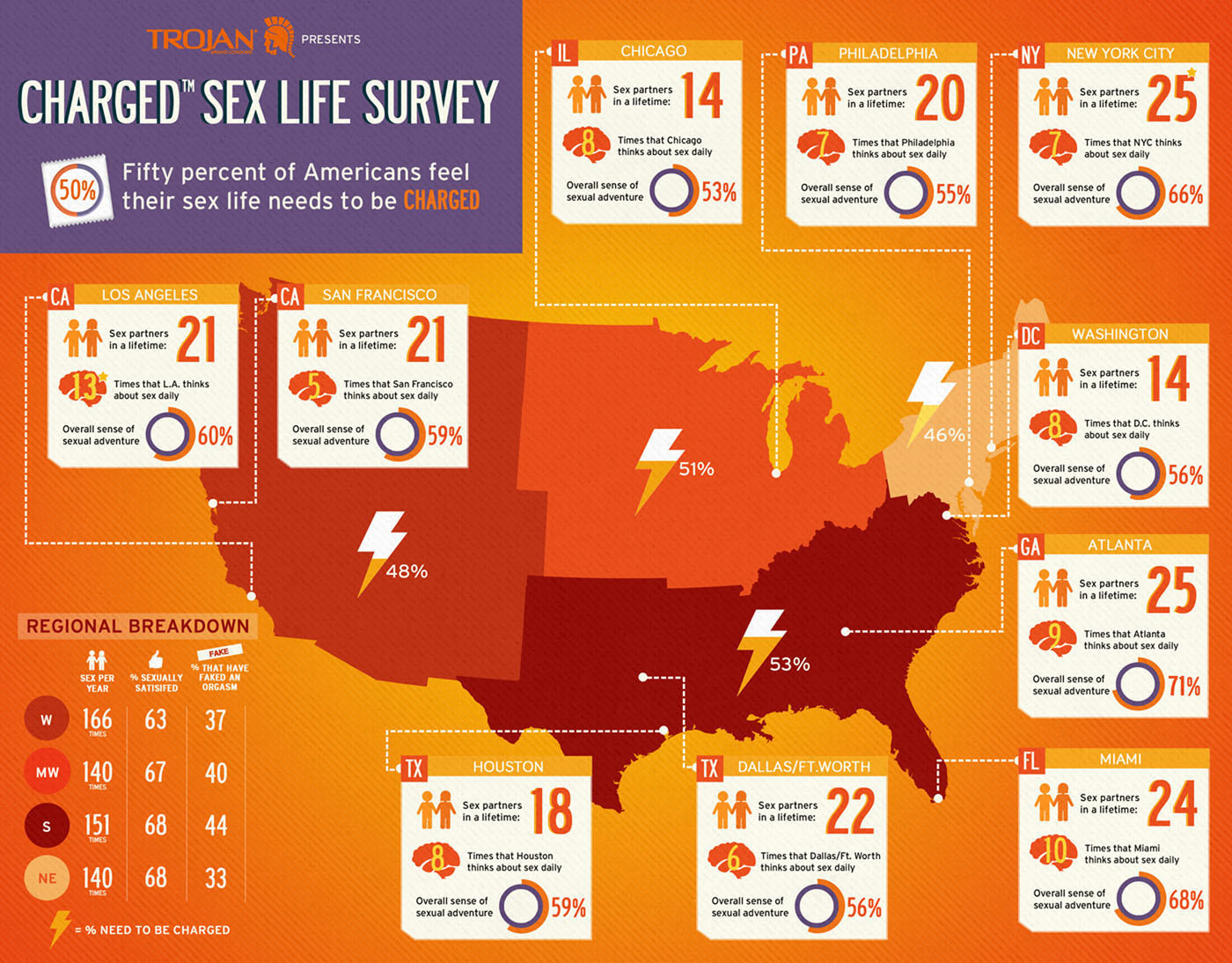
The double standard extends to sexual relationships as well. Dominican culture is pretty sexual: multiple partners are common, even expected. I say this with no judgement having come from San Francisco, a city in which the average person has 21(!) different sexual partners over their lifetime. (No, not me, mom). But under machismo, men can brag about their conquests while women have to keep quiet lest their reputation be irrevocably damaged. The double standard of machismo also dictates that "quiet" infidelity by men is to be tolerated, even it breaks the heart of every woman involved with the unfaithful man.
Machismo puts suffering women in another bind by restricting artistic expression. In the US woman can sing of their broken hearts and get rich doing it but Dominican popular music there is little space for female artists.
A few words about bachata
Bachata began as the music of brothels. Then it was the music of the campo, a period in which it endured a disdain similar to that urban intellectuals in the US have heaped upon country music, before eventually becoming the king of Dominican genres. It is lovely, melancholic music with a rhythm you can dance to.
A favorite old song of mine:
As the genre steadily marched toward universal acceptance it slowly changed. The rhythm stayed the same but the tempo sped up. Artists from the Dominican diaspora started incorporating pop influences from their time in Nueva Yol. Romeo Santo, the reigning king of contemporary bachata, is fluently bilingual and has cut songs with Drake.
What does it sound like now? Click, close your eyes, and listen:
If you are like me, you may have thought Romeo was a woman upon first listen. It's not just him. For the being most popular genre in a machista society, a surprising number of male bachata artists sing in a feminine style. This androgyny is present in the lyrical content as well.
To women or for them?
Some say that machismo is embedded in Spanish because the majority of nouns have gender. When speaking about a women, or to her, you use the feminine version of a word. When speaking about, or to, a man use the masculine form. When saying something as simple as "You are bad" you betray the gender of the object by saying either "bueno" (masculine) or "buena" (feminine). It is really hard to avoid using gender, even by accident.
Yet bachata does this all the time. Virtually all bachata is about love between men and women but it many of biggest songs refer not to men and women but just "you" and "I" in an ingeniously genderless fashion. This is not universal - the Romeo song above brims with rather grotesque, gendered expressions - but it is extremely common.
With high pitched vocals and androgynous lyrics, many contemporary bachatas written and performed by men could be sung by a woman without changing a single thing about the song. This brings me to the belatedly stated thesis of this piece: contemporary bachata, by accident or design, has evolved in such a way that the songs that best to permit the expression of female longing in a machisto society are the most popular.
Instead of singing merely to the women, male bachata artists sing in their place as well.
10 Seconds
When it comes to bachata, I prefer the old school of Leonardo Paniagua and Luis Seguro but I still appreciate the new style. My contemporary favorite is "10 Segundos by Zacarias Ferreria." I have probably heard this song - no joke - at least 300 times in the last 365 days and still I am not sick of the melody.
Hear:
Dominicans love to sing along, out loud, in public. About 200 of the 300 times I have heard this song, there was a woman singing along, reaching for the high notes in the chorus. It goes like this:
Yo te amo pero tú
buscas sexo y nada más
yo te amo pero tú
de amar bien no eres capaz.
"I love you, but you
look for sex and nothing more.
I love you, but you
are not capable of real love."
Cat and I recently celebrated one year in country. As fast as it has passed I am old enough to know that the next year will go even quicker. I could use this entry to reflect on all that's happened, things I've seen and done, the people I've met, etc. But instead I am thinking about machismo and bachata, two things that are a daily part of my experience here.
Bachata is, by far, the most popular genre of Dominican music. Machismo, is, welllll . . .
The male animal
Machismo is the cultural pattern that defines gender relations in the DR and, indeed, much of Latin America. The word machismo derives from the Spanish macho, which means "male animal." Basically this means different behavior standards for men and women with the difference favoring men. This manifests itself in many ways but generally means that men are free to do as they like while women are expected to be responsible and "respectable" - which usually means staying at home to cook and clean and take care of children.
The double standard extends to sexual relationships as well. Dominican culture is pretty sexual: multiple partners are common, even expected. I say this with no judgement having come from San Francisco, a city in which the average person has 21(!) different sexual partners over their lifetime. (No, not me, mom). But under machismo, men can brag about their conquests while women have to keep quiet lest their reputation be irrevocably damaged. The double standard of machismo also dictates that "quiet" infidelity by men is to be tolerated, even it breaks the heart of every woman involved with the unfaithful man.
Machismo puts suffering women in another bind by restricting artistic expression. In the US woman can sing of their broken hearts and get rich doing it but Dominican popular music there is little space for female artists.
A few words about bachata
Bachata began as the music of brothels. Then it was the music of the campo, a period in which it endured a disdain similar to that urban intellectuals in the US have heaped upon country music, before eventually becoming the king of Dominican genres. It is lovely, melancholic music with a rhythm you can dance to.
A favorite old song of mine:
As the genre steadily marched toward universal acceptance it slowly changed. The rhythm stayed the same but the tempo sped up. Artists from the Dominican diaspora started incorporating pop influences from their time in Nueva Yol. Romeo Santo, the reigning king of contemporary bachata, is fluently bilingual and has cut songs with Drake.
What does it sound like now? Click, close your eyes, and listen:
If you are like me, you may have thought Romeo was a woman upon first listen. It's not just him. For the being most popular genre in a machista society, a surprising number of male bachata artists sing in a feminine style. This androgyny is present in the lyrical content as well.
To women or for them?
Some say that machismo is embedded in Spanish because the majority of nouns have gender. When speaking about a women, or to her, you use the feminine version of a word. When speaking about, or to, a man use the masculine form. When saying something as simple as "You are bad" you betray the gender of the object by saying either "bueno" (masculine) or "buena" (feminine). It is really hard to avoid using gender, even by accident.
Yet bachata does this all the time. Virtually all bachata is about love between men and women but it many of biggest songs refer not to men and women but just "you" and "I" in an ingeniously genderless fashion. This is not universal - the Romeo song above brims with rather grotesque, gendered expressions - but it is extremely common.
With high pitched vocals and androgynous lyrics, many contemporary bachatas written and performed by men could be sung by a woman without changing a single thing about the song. This brings me to the belatedly stated thesis of this piece: contemporary bachata, by accident or design, has evolved in such a way that the songs that best to permit the expression of female longing in a machisto society are the most popular.
Instead of singing merely to the women, male bachata artists sing in their place as well.
10 Seconds
When it comes to bachata, I prefer the old school of Leonardo Paniagua and Luis Seguro but I still appreciate the new style. My contemporary favorite is "10 Segundos by Zacarias Ferreria." I have probably heard this song - no joke - at least 300 times in the last 365 days and still I am not sick of the melody.
Hear:
Dominicans love to sing along, out loud, in public. About 200 of the 300 times I have heard this song, there was a woman singing along, reaching for the high notes in the chorus. It goes like this:
Yo te amo pero tú
buscas sexo y nada más
yo te amo pero tú
de amar bien no eres capaz.
"I love you, but you
look for sex and nothing more.
I love you, but you
are not capable of real love."
Wednesday, March 1, 2017
A few words about voudou
The most recent episode of Cat's podcast is about our visit to a batey, which is is a type of company town structured around a sugar plantation. Most of the plantations went bust in the 80s but the communities persist. Due to historical and economic factors bateys tend to be poor, congested and populated primarily by Dominicans of Haitian descent or recent Haitian immigrants.
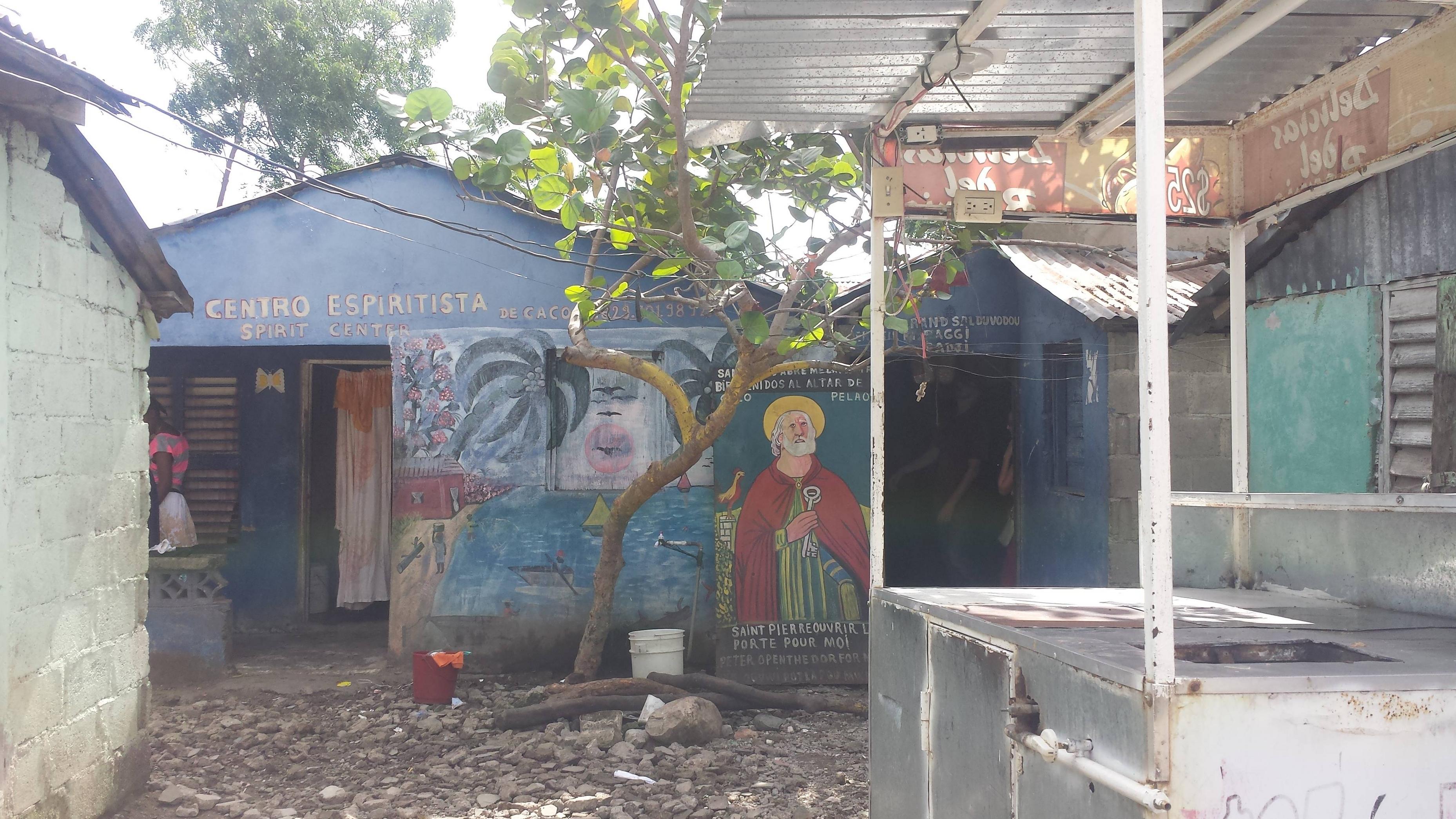
Essentially, Haitian voudou is a mixture of Roman Catholic rituals and traditional African beliefs. The slaves that were brought to the island were forbidden to practice their native religion so they gave it a Catholic makeover. It's a much better fit than you might expect!
In both belief systems there is a Bondye ("Good God") who is not directly knowable without the intervention of a priest. This Supreme Being is supported by lesser spiritual powers who are also the objects of devotion.
In voudou the African lwa ("spirits") are associated with the Catholic Saints. For example Papa Legba, who guards the entry into the spirit world is represented by "San Pedro" (St. Peter) the guard of the Pearly Gates.
 |
| Saint Peter |
St. Jean D'Arc (Joan of Arc - Haiti was originally a French colony) is associated with Ersulie Freda.
 |
| I have no idea what she does. |
John the Baptist . . .
 |
| John is to the right of Jack |

The images of the saints adorns the walls but the center of the action is the altar.
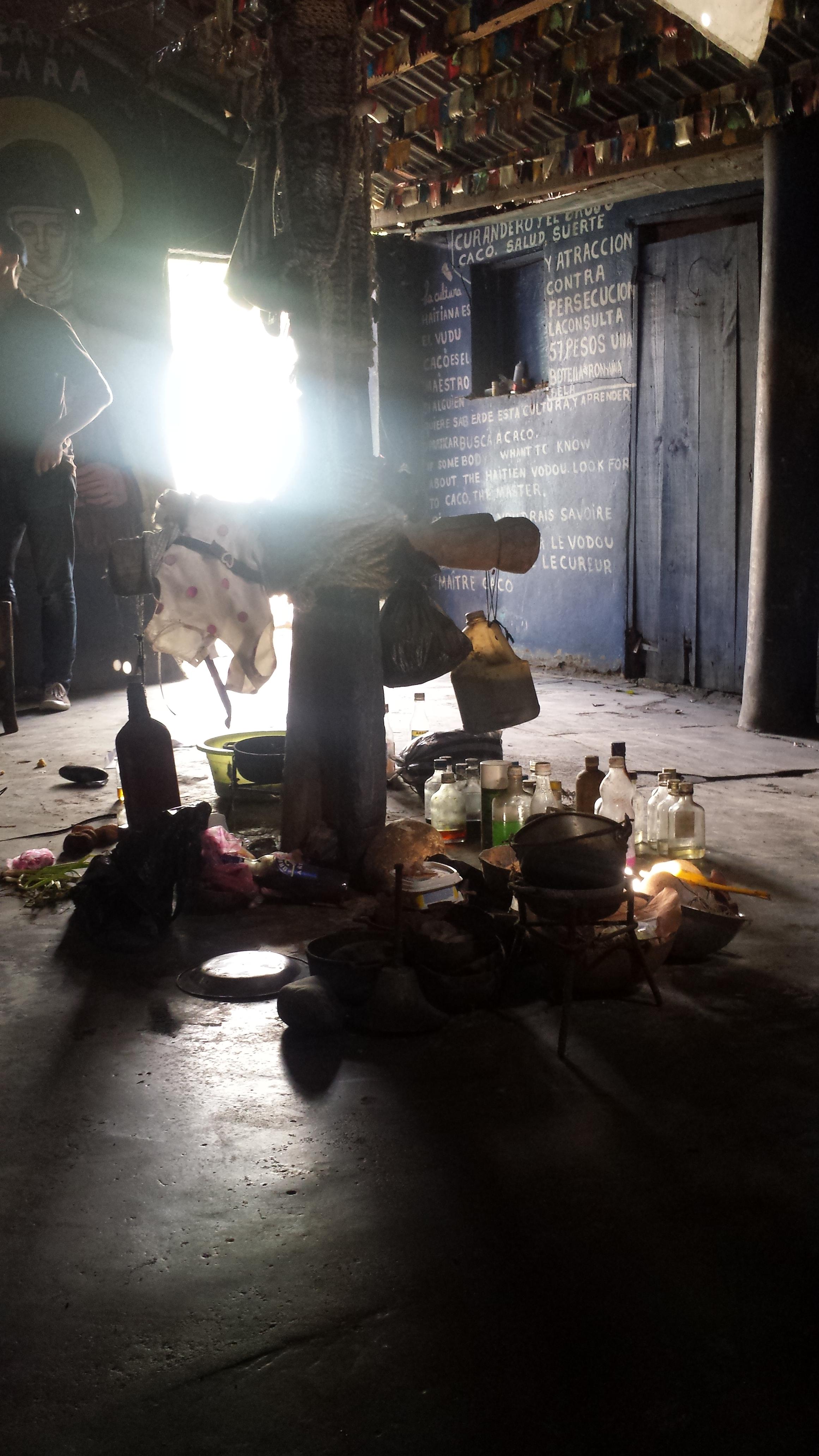 |
| Offerings from the devout |
They answer prayers.
Thursday, February 9, 2017
Blogging about blogging about Hospitality
This post is part of Blogging Abroad's 2017 New Years Blog Challenge, week five: Hospitality.
Normally, I put the above disclaimer/announcement at the bottom of each entry but this time it's up top because I wanted to reflect a bit upon the challenge itself.
When I started this blog my goal was to write an entry a week. After a strong start I fell off pretty quickly. I attribute that to initially being too overwhelmed by the new experience to have anything to say and then shortly thereafter not having much to talk about. Life in the campo moves slow. Not a whole lot happens. I appreciate the challenge for providing me with exterior motivation to write more regularly.
I also appreciate it for helping me shake up my writing style. In case the above verbiage didn't clue you in, I tend to be rather discursive. Bullet points, headings, etc., don't come natural to me. I have only embraced them recently because I've been receiving a weekly email suggesting that I use them.
Take this week. The theme? Hospitality. The prompts?
• List: Share 3-5 things your host community does to make you feel welcome
• Story: Recount the welcome you received and how you felt when you first arrived to your host country
• Reflect: Talk about what one unexpected aspect of your community that makes you feel the most welcome
• List: Share the top greetings you hear in your host country (explain the translations if it's in another language) - this would also be a fun one to create with video
• Profile: Highlight a community member who best represents hospitality to you
Dude, I feel like I did these already. List? I already did a list in my most recent, non-video entry.
Story? I took this challenge to get away from long narratives. I also discussed my arrival (in part) in my initial entries.
List (again) of greetings? Well, I already wrote about a buen tiempo. Cat and I also discuss other "top greetings" at length in this episode of the podcast
Profile a community member? I did that for my first entry in the challenge.
I guess that leaves me no option but to reflect. I'll try to keep it brief. :-) Ahem.
I can't say that the hospitality here was unexpected. Dominican gregariousness is legendary. I have literally had strangers flag me down from the street and invite me into their homes. I am not surprised that missionary religions like the Jehovah's Witnesses or The Church of Jesus Christ of Latter Day Saints are making steady inroads here. This has to be the easiest country in the world to be a missionary. Whereas in the US Mormons and Testigos often get the door slammed in their face here they are offered coffee.
So I am not surprised to feel welcome. But there is one thing that has played a surprising role in making me feel at home that I have been mulling over for a while now. I am pleased and surprised by the freedom which Dominicans in the campo grant their children.
Steadily over the course of my life American society has evolved into a paranoid police state regarding the safety of children. Even I, who grew up with "stranger danger" PSAs all over the television had a relatively independent childhood compared to today's helicopter parents. If I told my parents where I was going, who I was going to be with, and when I would be home, I was pretty much free to do as I pleased. Dominicans give their children even more liberty.
When I worked with high school interns in San Francisco I had to have my fingerprints taken for a background check. Here, I when Cat and I started a hiking group for muchachos we didn't even need permission slips. Instead of seen as a potential threat we were assumed to be trustworthy. That's how confianza works.
So what does that have to do with making me feel welcome?
Well, in addition to the warm and fuzzy feeling that comes with being valued as a sano (literally "healthy" but here meaning something like "wholesome") community member by my fellow adults, the muchachos are good at making you feel wanted.
Despite nearly a year in country, I still get overwhelmed sometimes. I leave my project (which I really need to write about one of these days) feeling tired and walk home with my head spinning. But when I get to our little barrio the local kids call my name and greet me with a hug or a high five. It's hard to be depressed when you are welcomed home by people who are literally jumping for joy to see you.
It's also been great for my Spanish. You can ask kids /anything/ and they'll give you a straight answer. They don't care if you make mistakes and they don't mind if you ask them to repeat themselves. With adults, I usually stop asking for clarification after the 3rd time.
Thursday, February 2, 2017
Sunday, January 29, 2017
5 things that make me hopeful for my community
Obligatory Preferatory Paragraph
I think in paragraphs. I sometimes speak in them - much to the annoyance of Cat - and I write in them as well. To embrace this Blog Challenge as an actual incentive to try something new instead of just indulging in my old habits, I've opted to write this entry as a listicle.
1. Good relations between Dominicans and Haitians
Unlike the rest of Latin America, the DR celebrated it's independence not from Spain but from it's neighboring nation. Things have been pretty tense between the two cultures since that time. So I am especially grateful to see the Dominicans in my community treating Haitian immigrants with a respect and decency that its not universally common across the nation.
2. Multi-generational environmental awareness
While deforestation is exactly improving fast enough, there is a wide-spread awareness of the problem. The old hands know it firsthand from comparing the paisaje ("landscape") of their youth to the bald hills of today, and they have instilled this knowledge in their children. The local national park was declared in 1995 and the local technical high school teaches conservation.
3. Conservation of cultural
When cheap digital cameras came to the pueblo in the form of cell phones, what is the first thing the jóvenes (youth) did? Well, after they got on WhatsApp. they made a movie telling the story of a local Don and Doña. Two, actually!
The first, Una Boda de Oro, focused on their courtship and marriage. Cat and I are very proud to have arranged a local that featured this film.

A second chapter, Teofilo Mora 1966 which premiered Wednesday night at the local community center, tells the rest of the story.
They have be abandoning the old ways in the city, but here in the capital, the young people still young ones can play the traditional music and still dance the traditional dances no matter how much time they spend chateando.
4. Steady arrival of modern convenience
30 years ago this village was all wooden shacks. They had neither running water, electricity or telephones. Now, it has suburban style houses with all the essential services (however imperfectly implemented) - plus internet. Hopefully this comfort and convenience in the campo will make the capital and points further afield less alluring and thus slow the brain drain.
5. Religious diversity and tolerance
Two generations ago, the pueblo was mono-culturally Catholic. Now it has multiple, well-established Evangelical congregations and a thriving Salon de Reinos (Kingdom Hall) for the local Jehovah's Witnesses. I am officially fine with Catholicism but am a fan of religious diversity because new ways of worship often means new ideas.
Like ethnic inclusion, religious tolerance better prepares a society (however small) to whether the changes in a rapidly evolving world. Unsurprisingly, the members of these minority religions have a major religion in the local culture. Los evangélicos and los Testigos are well-represented in non-religious leadership positions around town.
CHALLENGE FAIL
OK, so my bullet points turned out to be paragraphs. At least I tried. Thinking positive, especially as I emerge from a mild holiday induced depression, was challenging enough.
This post is part of Blogging Abroad's 2017 New Years Blog Challenge, week four: Change and Hope. My final one actually! I hope you've enjoyed the more regular posting schedule. I'll be taking next week off. If you want something to read in that absence give the other bloggers participating in this challenge a try.
I think in paragraphs. I sometimes speak in them - much to the annoyance of Cat - and I write in them as well. To embrace this Blog Challenge as an actual incentive to try something new instead of just indulging in my old habits, I've opted to write this entry as a listicle.
1. Good relations between Dominicans and Haitians
Unlike the rest of Latin America, the DR celebrated it's independence not from Spain but from it's neighboring nation. Things have been pretty tense between the two cultures since that time. So I am especially grateful to see the Dominicans in my community treating Haitian immigrants with a respect and decency that its not universally common across the nation.
2. Multi-generational environmental awareness
While deforestation is exactly improving fast enough, there is a wide-spread awareness of the problem. The old hands know it firsthand from comparing the paisaje ("landscape") of their youth to the bald hills of today, and they have instilled this knowledge in their children. The local national park was declared in 1995 and the local technical high school teaches conservation.
 |
| Mural on the side of a local store |
3. Conservation of cultural
When cheap digital cameras came to the pueblo in the form of cell phones, what is the first thing the jóvenes (youth) did? Well, after they got on WhatsApp. they made a movie telling the story of a local Don and Doña. Two, actually!
The first, Una Boda de Oro, focused on their courtship and marriage. Cat and I are very proud to have arranged a local that featured this film.

A second chapter, Teofilo Mora 1966 which premiered Wednesday night at the local community center, tells the rest of the story.
They have be abandoning the old ways in the city, but here in the capital, the young people still young ones can play the traditional music and still dance the traditional dances no matter how much time they spend chateando.
4. Steady arrival of modern convenience
30 years ago this village was all wooden shacks. They had neither running water, electricity or telephones. Now, it has suburban style houses with all the essential services (however imperfectly implemented) - plus internet. Hopefully this comfort and convenience in the campo will make the capital and points further afield less alluring and thus slow the brain drain.
 |
| ¨What a difference 300 feet of steel makes" |
5. Religious diversity and tolerance
Two generations ago, the pueblo was mono-culturally Catholic. Now it has multiple, well-established Evangelical congregations and a thriving Salon de Reinos (Kingdom Hall) for the local Jehovah's Witnesses. I am officially fine with Catholicism but am a fan of religious diversity because new ways of worship often means new ideas.
Like ethnic inclusion, religious tolerance better prepares a society (however small) to whether the changes in a rapidly evolving world. Unsurprisingly, the members of these minority religions have a major religion in the local culture. Los evangélicos and los Testigos are well-represented in non-religious leadership positions around town.
CHALLENGE FAIL
OK, so my bullet points turned out to be paragraphs. At least I tried. Thinking positive, especially as I emerge from a mild holiday induced depression, was challenging enough.
This post is part of Blogging Abroad's 2017 New Years Blog Challenge, week four: Change and Hope. My final one actually! I hope you've enjoyed the more regular posting schedule. I'll be taking next week off. If you want something to read in that absence give the other bloggers participating in this challenge a try.
Thursday, January 26, 2017
Drowning in Water
The Meaning of Water
A favorite parable of mine goes like this:
Two young fish are swimming along side-by-side talking about the things youngs fish talk about when an elder fish says to them in passing:
"'Morning fellows! How's the water today?"
The young wish swim on without reply. Only When the strange, old fish has safely passed does one turn to the other and say:
"What the heck is water?"
Culture is like water. We swim in it without knowing it for what it is. We take it for granted.
(For a more extensive exploration of this idea, I recommend the following commencement speech by David Foster Wallace.)
This parable has been helpful to give me perspective on my own
culture. To be more see more of the thins that I take for granted. when I
lived inside my own culture.
Lately, though this has metaphor has taken on a whole new dimension of meaning.

A Very Bulla Christmas
The holidays were hard for me. (Cat, too). I would have been hard pressed to explain it at the time but with the wisdom of a few weeks perspective I can see it was a matter of cultural difference.
Being out of my own culture meant swimming in unfamiliar waters. The winter holidays in the DR are just different and that made me uncomfortable and a bit depressed in a way I wasn't anticipating.
So, you ask, how are they different?

These lights on a neighbor's house are one on a short of five items that DR and US Christmas celebrations have in common. The others? Family comes home, people take a week or more days off work, they celebrate with food and drink, and the special day gets special recognition in the church.
(We were invited to Mass but we didn't go. I now wish we had - the familiarity might have been grounding for me.)
Gift giving? That's really only for kids here and it's done on the el Día de los Tres Reyes, which is January 6. In the Hispanic tradition the Three Kings give the gifts instead of the Germanic, quasi-pagan figure of Santa Clause.
Christmas trees are a bit too nothertn, too. There's been some adoption of "l arbolito in the cities but here in the campo with a significant deforestation problem "holiday cheer" is not a good enough reason to cut down a perfectly good tree.
Christmas music? The two or three songs I heard para la Navidad (yes, one of them was by Jose Feliciano) were Mexican imports. These were far outnumbered by the secular bachata, merengue, salsa and dembow tunes. These I heard all night, every night, from la Noche Buena (Christmas Eve) through la Noche Vieja (New Year's Eve).
The Spanish word for this - used with pride by some locals - is bulla which translates as "racket." This is, of course, directly contrary to the Christmas traditions of Northern Europe and the Northern America. Underneath all the crass commercialism, Christmas in the United States is still a spiritual and introspective time. You stay in because it's cold. You spend time with your family. You try to be nice in a way that you aren't normally.
The folks in my campo mostly use la Navidad as an excuse to get together with people they don't normally see and hacer la fiesta. They drink and dance in la discoteca. Because Christmas just isn't that big a deal here.
What is a big deal is Semana Santa (Holy Week), the last week of Lent before Easter. I'd love to write about it's role in Dominican culture but that will have to wait until I've actually experience it.
It all makes sense in perspective. I come from a society that is Protestant Christian at it's core at it's core while Dominican roots are distinctly Catholic. The water felt wrong, so it was hard for me to go with the flow.
I wonder how Dominican immigrants to the US feel in to find themselves in a society where their biggest cultural event isn't celebrated outside of a few ethnic enclaves? I imagine that the first Semana Santa they spend away from home passes not so - how, shall I put it? - swimmingly.
This post is part of Blogging Abroad's 2017 New Years Blog Challenge, week three: Cultural Differences.
A favorite parable of mine goes like this:
Two young fish are swimming along side-by-side talking about the things youngs fish talk about when an elder fish says to them in passing:
"'Morning fellows! How's the water today?"
The young wish swim on without reply. Only When the strange, old fish has safely passed does one turn to the other and say:
"What the heck is water?"
Culture is like water. We swim in it without knowing it for what it is. We take it for granted.
(For a more extensive exploration of this idea, I recommend the following commencement speech by David Foster Wallace.)
Lately, though this has metaphor has taken on a whole new dimension of meaning.

A Very Bulla Christmas
The holidays were hard for me. (Cat, too). I would have been hard pressed to explain it at the time but with the wisdom of a few weeks perspective I can see it was a matter of cultural difference.
Being out of my own culture meant swimming in unfamiliar waters. The winter holidays in the DR are just different and that made me uncomfortable and a bit depressed in a way I wasn't anticipating.
So, you ask, how are they different?

These lights on a neighbor's house are one on a short of five items that DR and US Christmas celebrations have in common. The others? Family comes home, people take a week or more days off work, they celebrate with food and drink, and the special day gets special recognition in the church.
(We were invited to Mass but we didn't go. I now wish we had - the familiarity might have been grounding for me.)
Gift giving? That's really only for kids here and it's done on the el Día de los Tres Reyes, which is January 6. In the Hispanic tradition the Three Kings give the gifts instead of the Germanic, quasi-pagan figure of Santa Clause.
Christmas trees are a bit too nothertn, too. There's been some adoption of "l arbolito in the cities but here in the campo with a significant deforestation problem "holiday cheer" is not a good enough reason to cut down a perfectly good tree.
Christmas music? The two or three songs I heard para la Navidad (yes, one of them was by Jose Feliciano) were Mexican imports. These were far outnumbered by the secular bachata, merengue, salsa and dembow tunes. These I heard all night, every night, from la Noche Buena (Christmas Eve) through la Noche Vieja (New Year's Eve).
The Spanish word for this - used with pride by some locals - is bulla which translates as "racket." This is, of course, directly contrary to the Christmas traditions of Northern Europe and the Northern America. Underneath all the crass commercialism, Christmas in the United States is still a spiritual and introspective time. You stay in because it's cold. You spend time with your family. You try to be nice in a way that you aren't normally.
The folks in my campo mostly use la Navidad as an excuse to get together with people they don't normally see and hacer la fiesta. They drink and dance in la discoteca. Because Christmas just isn't that big a deal here.
What is a big deal is Semana Santa (Holy Week), the last week of Lent before Easter. I'd love to write about it's role in Dominican culture but that will have to wait until I've actually experience it.
It all makes sense in perspective. I come from a society that is Protestant Christian at it's core at it's core while Dominican roots are distinctly Catholic. The water felt wrong, so it was hard for me to go with the flow.
I wonder how Dominican immigrants to the US feel in to find themselves in a society where their biggest cultural event isn't celebrated outside of a few ethnic enclaves? I imagine that the first Semana Santa they spend away from home passes not so - how, shall I put it? - swimmingly.
This post is part of Blogging Abroad's 2017 New Years Blog Challenge, week three: Cultural Differences.
Subscribe to:
Posts (Atom)