Tuesday, July 19, 2016

Don't take my word for it


The truth is,  Cat and I are not the only volunteers in this little pueblo in the mountains. We have recently received un jóven named Chase who is kindly assisting us with an ecotourism project. He is here on an internship between Washington and Lee University and Onwards,  Inc.

Like me, he maintains a blog of his experiences here.

Sunday, July 17, 2016

I Heart Evangelical Christians

My wife has a hard time with heavy metal. When I listen to Falls of Rauros or Wolves in the Throne Room, I do it through headphones. She can't take the screaming. She is quite sonically adventurous - she likes everything from classical music to an experimental genre that is called, literally, "Noise" -  just not when it comes to certain extremes of the human voice. It reminds her of being yelled at.

So she has something of a hard time when the Evangelical church two houses over from us gets going. I'm not trying in any way to disparage los evangélicos by saying that they're screamers. I am just trying to be accurate. I recognize that they might prefer the word "praise" (or in español, dar oración) but when you are praising so intensely that your voice breaks, you're screaming.

I kind of dig it! And not just because I am the guy that likes screaming music.

As I grow older and become more invested in my own spiritual path the more I celebrate the spiritual expression of other people.  I think it's a good thing that evangélicos pray in the way that they think is best. I also think I get why they scream. Sometimes a feeling is so powerful that it possesses the entire body and forcefully escapes through the mouth. In metal this process is cathartic - bad feelings get shouted out - but it happens to Evangelicals when they are having a good time.

This sonic similarity is one of many things that I am surprised to appreciate about Evangelical Christianity as it is practiced in the Dominican Republic. It might be a bit early to call, but I'll go on the record as a fan. Evangelicals play a surprisingly large role in society here given that they are outnumbered by Catholics by more than two to one.

Despite being extremely expressive in their praise - I've been to other Evangelical churches and even the ones where they don't scream the volume is still turned up to 11 - they serve as a moderating force in Dominican culture. Dominicans dance and drink and do the dirty deed at rates only barely exceeded tourists in Punta Cana.  I don't think that drinking, dancing and doin' it are inherently bad but I do think that these stats for alcoholism and teen pregnancy suggest that Dominicans, as a whole, need to tone it down a little bit.

Which is exactly what evangélicos do. They don't drink, they don't dance (outside of church) and they (allegedly) don't do it before they're married. Yes, all human beings are capable of hypocrisy and, yes, Catholics have moral precepts too, but from my own observations it seems to me that your average evangelical en la República takes their commandments more seriously than your average católico.

I think that this is because Evangelical Protestantism is a relatively new thing here. I have met some multi-generational Evangelical families but I have met more new converts away from Catholicism. This is important not because I am an ex-Catholic myself (though I am), nor because I am a fan of Evangelical doctrine (we actually have profound disagreements) but because when you convert you are by default making a choice. And when you make a choice about a religion you necessarily have to consider your own behavior.

This isn't just a Dominican thing. It happens in other cultures, too.  I, un americano, came up Christian but converted to Buddhism when I needed to make some big changes in my life. Korea, a traditionally Buddhist country, has high rates of alcoholism despite the Buddhist prohibition against abusing alcohol. What religion to Koreans convert to when they want to turn it from 11 to 7? Christianity.

I am into choosers, even if it's a choice I don't particularly agree with. It suggests a certain liberalism, not in the political sense of the word but meaning "openness to new ideas."

This surprised the heck out of me when I first realized it. Like many liberal-ish Americans who came of age during the Bush years the I associated the word "Evangelical" (meaning merely that you preach your faith to others as opposed to practicing it at home) with bad pop music and outsized influence in public policy. I had a negative conception that can only be described as prejudice. How ironic is it my biggest experience of cultural exchange in Peace Corps is a with group I already thought I knew?

The same is true for Jehovah's Witnesses. Don't worry, I won't be knocking on your door anytime soon but I now know something about their practice (as opposed to nothing) and so far I like what I have seen. My project partner is a testigo and upon visiting his house I was pleasantly surprised to discover a shelf full of books - not the most common site here. It turns out that becoming a full-fledged testigo requires a lot of study and therefore the J-dubs are seriously into literacy. The book shelf didn't bear only JW books. They were just books about the world. I am not into their doctrine but I admire the outward facing interest.

I hear that Mormons are on the upswing here, too. This doesn't surprise me. Outward facing interest aside, the RD has to be the easiest assignment in todo el mundo for missionaries, be they Mormon or any other group. The Dominican national pastime (other than baseball) is sitting on the front porch visiting with folks. They prefer folks they know but in a pinch they'll flag down a stranger and give them coffee.

I believe that these different denominations represent the introduction of religious diversity to RD. Even if it's just new flavors of Christianity right now, it's only a matter of time before it includes other religions. That's how it worked in Europe and the US, after all. As a diversity loving heathen, I approve!

Sunday, July 10, 2016

Haitians and Hanukkah

When winter comes in the US, we say "Happy Holidays." As far greetings go it's pretty accurate but not very precise; most people aren't celebrating generic "holidays" but something more specific. As far as winter holidays go Ramadan is a moving target and Kwanzaa is an asterisk: the biggies, as we all know,  are Christmas and Hanukkah. So, what do we say to our baristas when we drop our change in the tip jar? Merry Christmas or Happy Hanukkah? Neither: we equivocate with "Happy Holidays," for fear of causing offense.

It's easy to see how we got here. Really, how can you tell if someone is Jewish or Christian by appearances alone? You can't!

Sure, sometimes we can hazard a guess and not strikeout. And there are signs we might look for: someone wearing a cross or a particularly ugly sweater is probably into Christmas. A bearded gentleman with prominent forelocks' and a kippe probably will not object to Happy Hanukkah.  We might listen for a name or accent to clue us in. If we are really comfortable (and most likely Jewish ourselves) we might judge by physiognomy.

Of course this is profiling in itself. And it doesn't always work.  Even Jews get it wrong sometimes. Hence, Happy Holidays.

It's July and I'm wondering, how can we tell Dominicans from Haitians? I ask because I am currently enrolled in a Kreyol class. My wife Cat and I stationed near the Haitian border and Kreyol, being tte language of Haiti, might come in handy. The chance to learn another language (Spanish) was one of the reasons we chose Peace Corps, so we're really excited to learn another and are to determined to use it.

Since there is no equivalent of "Happy Holidays" that covers both Spanish and Kreyol, I have to guess. Even though I know I'm going to get it wrong.

So I present here, more for my own mortification as for your edification, a shortlist of the "signs" I've discovered.

Color
Both Dominicans and Haitians have a lot of Africa in their history, but Dominicans are more intermixed with other groups than Haitians. If someone looks "black" in the American sense of the word, they are likely Dominican. If they look "African" they are likely Haitian.

But of course there are "African" looking Dominicans. And there is the fact that nationality is not a genetic trait. A person of 100% African Ancestry, born in Haiti, can magically transform with the right documentation. One of the most celebrated of all Dominican politicians, José Francisco Peña Gomez, a man many consider the first true leader to emerge after three decades of dictatorship was born to Haitian parents, orphaned by a massacre, adopted by Dominican parents and *poof* was magically transformed.

And there is the fact that there are light - even "white" - Haitians. So let's forget about color.

Class
Haitians are, unfortunately, almost universally impoverished. In my town of 2000, which is about half-Haitian, only 2 or 3 Haitian families own their home. The rest rent or squat. They often lack shoes and their clothes are little more than rags.

But national privilege does not guarantee subsistence and I have met Dominicans whose extremely humble house was indistinguishable for their Haitian neighbors and whose clothes were likely picked from the same paca.

So let's scratch class as well.

Occupation
Haitians, like Latin American immigrants in the US, bear the brunt of the agricultural grunt work. They often work longs hours in fincas owned by Dominicans where they are paid by the day.

But Dominicans, too, toil in fields not their own. And Haitians can do as well for themselves as any other group and I've heard a few own land, so maybe occupation isn't that helpful after all.

Language
Haitians speak Kreyol and Dominicans speak Spanish, right? But if *anything* is mutable it's language, right? So many I shouldn't get started with this one . . .

Accent
Kreyol is, well, a creole of many languages but the largely constituent in the stew is French, somany Haitians speak with a nasal acc--- You know what? Nevermind.

Happy Christmas in July!

Sunday, July 3, 2016

Helpful skills for life in the campo

How to swing a machete

How to dance*

How to ride on the back of a moto without using your hands

How to cook over a fogon*

How to take a bathe, shave, and brush your teeth using only one pitcher of water

How to tell if "Yes, soon" means "Yes, soon" or "No"*

How to keep up with a conversation while only understanding 40% of what is said

How to wash clothes by hand*

How to sit on the edge of the bed of a moving pickup without falling out

How to make coffee in an empty tin can*

How to hook up a solar panel

How to politely equivocate when answering the question whether or not your are going to have
children*

How to flush a toilet using a bucket of water

How to politely steer the conversation away from religion so you don't have to tell people you're not a Christian*

How to use a toilet with no seat

How to haggle politely while still getting a fair deal*

How to address someone's illiteracy without making them feel ashamed

How to hiss at someone politely*

How to say "Hi" in Kreyol

How to peel a green banana*

*Pending

Sunday, June 26, 2016

The Tropic of Beisbol


During CBT, I knew a family whose teenage son was a talented pitcher. I had trouble with his name (in my defense, there were eight kids) but I never forgot that he was (and presumably still is) actively being scouted by the Detroit Tigers. His father mentioned this to me with a particular type of pride that I recognized across the divide of language and culture. It was pride that American parents show when  their kids get into a great college. A sort of casual pride that implicitly acknowledges while this is awesome, it's something that happens to lots of people. It's something special, but not like "winning the lottery" special.

In my high school graduating class in the U.S. two students got into Harvard and another kid while another scouted by the Yankees. The kids who got into Harvard got pats on the back that showed the sort of comfortable pride I described above, while the baseball player got treated as being only slightly less important than the President of the United States.

Maybe it's a Yankees vs Tigers thing. Or maybe it's because the Dominican family I mentioned is one of achievers: the eldest daughter an abogada (lawyer) and the father is a major mover-and-shaker in the local political party.  But I think this disparity in enthusiasm is due to the fact that so many Dominicans go to the grandes ligas (Big Leagues).

Dominicans go to the Big Leagues at a greater rate than Americans go to prestigious universities; than Americans go to college at all; than Dominicans go to college at all; and, last but not least at a far greater rate than Americans go to the Big Leagues. It's not even close.

There are currently about 1000 Dominicans in the MLB system. That means in a nation of 11,000,000 people, about 0.0009% play professional ball in the U.S. With 30 clubs and about 250 players on the main team and associated farm teams that makes for about 7500 players in the Big League system. Even if the remaining 6500 are all natural born citizens of Los Estados Unidos (which they are not, but let´s pretend for simplicity's sake) in my nation of 300+ million that's only 0.00002%. That extra 0? That's literally an entire order of magnitude of difference.

All this to say that preparing Dominican youth for American ball is big business here. Would a $10 million contract blow your mind? Now imagine that feeling multiplied by an exchange rate of 45:1.

There are tons of professional trainers, many MLB veterans themselves, and there are dozens of baseball camps and academies. Like anything that involves children doing the work of adults it has it's dark side. Mother Jones called the training system  a "sweatshop" and unscrupulous trainers can pervert a mentoring relationship into something exploitative. This happens in the States with tiny gymnasts and teenage pop stars (paging Dr. Luke) but I daresay the stakes are higher here. Dominican parents are not blameless, but being broke is more forgivable than being merely fame hungry.

The business is quite a site to see, and I've only seen a little bit. And thankfully, what I've has so far, mostly been good.

In one corner of my pueblo, near the cemetery and there is a dusty play. The grass is mixed with weeds and trash blows around the bleachers, so I had assumed it was inactive. This puzzled me because I see kids playing pelota (which is what you call baseball when you play it with a stick and empty milk carton for a ball) in the street nearly everyday. It turns out I just went to the play on the wrong day. A friends brother is a trainer and one of the elementary teachers coaches a practice team.

I learned all of this when Major League Baseball came to host a clínica (clinic) in my isolated town in the mountains. Cat and I showed up to watch like everyone else in town, but unlike most of them I didn't know what clínica was. I assumed it was something vaguely medical, like a weigh-in for boxers or the type of "turn your head and cough" physical exam they put me through when I ran Cross Country in High School. It turns out a clínica is a miniature baseball training camp.

Like most Dominican events the clínica started an hour past the official time to allow everyone to show up. In that space Cat and I talked to a woman from MLB whose job is to improve the prospects of Dominican recruits to MLB. The big business I mentioned has a history of producing technically expert players with no emotional intelligence or critical thinking capabilities. They make poor decisions when in the heat of the moment and explode in the dugout afterwards. They may be professionals, but their personal development is arrested at the age they entered the system.

Players "released" from their contracts be retained by the Grandes Ligas as técnicos (technical trainers), managers, etc. and some will bounce around in the international leagues - not a horrible fate- but many, being booted from MLB is the end. With have no job experience and no other skills they have no future. Improving their prospects means improving education.

In addition to equipment, MLB donates books and scholarships to schools. They are also raising their internal standards. You can't play if haven't graduated high school, and you need to learn English - one of the most valuable job skills in the DR. And your parents need to be involved, from the beginning, and until you are an adult.

She says she watches the game now differently. She knows the players and their stories. When a Dominican player fouls a play and the camera zooms in for the reaction shot of his pained face she knows what he has to to through to get there and the problems that pain him back home.
Learning all this from her I looked again at the tecnicos as they put the boys through their paces. Some were retirement age and some were still young. I  wondered about their stories.

After the clínica I learned that last year a local boy had been released from his contract before he even made it to the States. He had been using his pending fame to chat up women, something prohibited during training. Clearly, he still had some growing up to do.
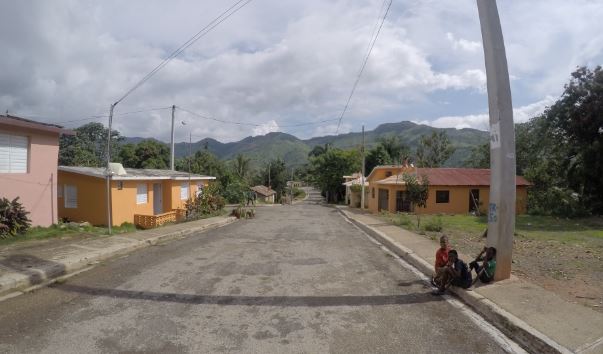
Sunday, June 19, 2016

A Race from Top to Bottom

Our first few weeks have mostly been concerned with getting to know our way around but we've already been able to participate in a satisfying project. It was not just technically outside of my site but also technically out of my province and far outside of my assigned project. Though it took place just up the mountain road from our pueblo when we hopped out of the pickup bed we were no longer in Elias Piña but Dajabon. And just as I don't live in the hot and dry Elias Piña of the south, this was not the busy and bustling Dajabon of the famed international market. We were in a small hillside village and we were there to plant trees.

The project was coordinated in part by another PCV and an NGO but most of the work was done by locals. The trees had been grown in a vivero (plant nursery) owned by the local Asociación de Producción de Bosques (Reforestaction Association) and the lion's share of the labor was done by local high school students.

The land was steep and the day was hot and the bosquedores had grown some 2000 pines and other native trees for us to plant. We worked the entire hillside from the bottom to the top and back down again. The jovenes (youth) approached the job with the uneven effort of teenagers everywhere. Some worked, but the kids who were literally too cool for school (they got the day off for volunteering) chatted in the shade. My work with troubled youth in the States has taught me skills rooted in positive reinforcement to challenge and motivate the disengaged. This worked with some of them, but the doña's approach was more effective. "Look at me! I'm over 60 years old and I'm dripping with sweat! What are you, flowers?"

Dominicans, generally speaking, are more direct with their children than American parents but slightly less so than American drill sargents. They worry about delincuencía (juvenile delinquency) but this to me seemed more like garden variety laziness. Also, some of the muchachos would likely be working in the fincas (agritultural tracts of land) later that week and possibly for the rest of their lives so I can't blame them for lack of enthusiasm. Still, we got the work done in time for lunch. We were assisted by a kicky mule who dutifully hauled saddlebags of matitas (seedlings) from the bottom of the slope to the top. He was a huge help but you had to steer clear of his hindlegs.

The land we planted was owned by the bosquedores so we know the trees won't be cut down but in the national parks it's a different story. The slopes of nearby Nalga de Maco are steadily being denuded of their timber. Some blame Haitians coming over the border to harvest carbón (charcoal) but more often than not it is poor Dominicans. Without better prospects the best way to make a living along the border is to plant beans in the hillside and sell them at market.

They lack land and opportunities but not consciencia. Dominicans are well-educated on the problem of deforestation. Haiti is so badly deforested you can see the difference from space. During the years of dictatorship and caudillisimo the Dominican forestry service was militarized and illegal loggers and farmers were jailed. Today, enforcement is lax. I imagine it is a grim business. Just barely getting by and knowing you're not doing yourself any favors them in the long run.

Every time it rains the water washes loose clay from the hillside where it runs into the valley where it runs in a ruddy band in the river. The locals tell me that the river is wider and deeper than it used to be. Without trees to drink it it the water flows into the valley. Without trees to retain the moisture and release it as mist it rains less and each season grows hotter. Climate change is real.

One local I talked to likened it to a race between deforestation and reforestation. It remains to be seen which side will win but I got back in the pickup proud, tired, and happy to have carried the baton a little further in the right direction.